
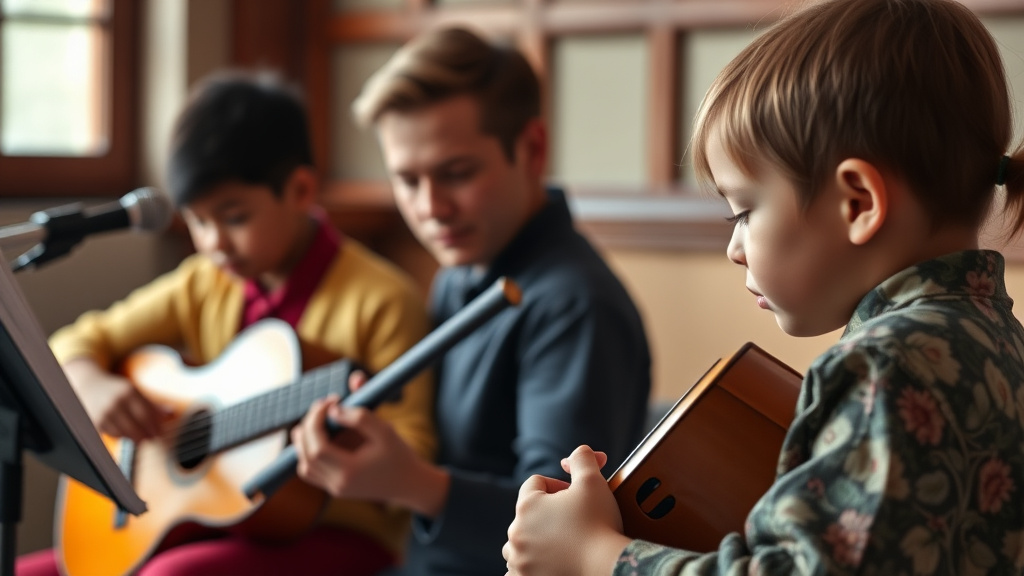
For decades, classical music has captivated audiences with its sophistication and depth, but new findings show its profound impact extends much further than the concert stage. New evidence demonstrate that children enrolled in formal music instruction achieve notable progress, from enhanced cognitive abilities and better school results to better emotional control and social skills. This article explores the strong support supporting these conclusions, looking at how listening to classical music and professional training influences developing brains and contributes to holistic child development.
Cognitive Development and Educational Achievement
Classical music education acts as a strong force for mental growth in children, activating multiple brain regions simultaneously. Research regularly shows that students involved with organized music training exhibit stronger neural pathways, particularly in areas governing memory, attention, and mental planning. These mental gains reach further than musical contexts, resulting in quantifiable progress across academic disciplines. Children exposed to classical music training develop improved reasoning capacity and show improved aptitude for sustained focus during intricate work.
The academic advantages of classical music instruction manifest across standardized assessments and academic performance measures. Students with music training typically achieve better results in mathematics and reading comprehension versus their peers without music training. This relationship demonstrates the complex cognitive requirements of music study, which requires simultaneous handling of rhythm, melody, and harmony. Furthermore, the focus and training practices cultivated through music instruction foster academic determination and engagement, contributing to overall academic achievement and enduring success patterns.
Advanced Mathematical Reasoning
The link between classical music and mathematical ability constitutes one of the most well-documented connections in educational research. Music theory naturally includes mathematical concepts such as ratios, proportions, and spatial reasoning, creating a natural bridge between musical and numerical thinking. Children studying classical instruments cultivate superior pattern-recognition capabilities and spatial visualization abilities, both critical to mathematical competency. This cognitive overlap illuminates why music students repeatedly exceed peers in geometry, fractions, and algebraic reasoning.
Long-term research monitoring students’ mathematical progress reveal that musical training participants sustain performance advantages throughout their academic careers. The analytical examination needed for musical composition and performance strengthens analytical thinking capabilities essential for advanced mathematics. Additionally, the step-by-step progression of studying music mirrors math problem-solving approaches, reinforcing analytical thinking patterns. These findings suggest that classical music education provides mental support structures that significantly improves mathematical learning capacity in young learners.
Strengthened Language Abilities
Classical music training markedly strengthens linguistic development through mechanisms that enhance auditory processing and phonological awareness. Music training improves children’s ability to distinguish subtle sound variations, a skill directly transferable to language acquisition and phonemic awareness. Students engaged in classical music study demonstrate improved vocabulary retention, reading fluency, and comprehension skills compared to non-musical peers. The auditory discrimination developed through music instruction enhances phonetic sensitivity, facilitating enhanced language learning and literacy development.
The advantages extend to both native language proficiency and language learning in non-native contexts, with music-trained showing accelerated progress in multilingual contexts. Classical music education cultivates greater attunement to language subtleties, prosody, and intonation patterns vital for effective communication. Evidence demonstrates that children with structured music education reach improved performance on language assessments and exhibit stronger communication skills. These language advantages reflect the significant relationships between musical and linguistic processing centers in the growing mind.
Emotional and interpersonal Expansion
Classical music training develops emotional intelligence in children by encouraging them to convey and communicate intricate emotions through performance. As students learn to navigate sophisticated musical works, they develop heightened emotional awareness and emotional control. Evidence suggests that young musicians demonstrate enhanced compassion, as they learn to express nuanced emotions through their instruments. This emotional literacy translates into enhanced emotional resilience and resilience in daily situations.
Collaborative music-making develops essential social skills, as ensemble participation requires attentive hearing, teamwork, and shared respect among peers. Children participating in orchestras or chamber groups develop the ability to work toward common objectives while valuing individual contributions. These engagements enhance self-belief, lower social tension, and create lasting friendships. Studies show that young musicians exhibit more pronounced leadership traits and enhanced peer relationships compared to their non-musical peers.
